Normal Hair Loss Occurs Daily
Losing some hair every day is a biological requirement, and understanding why it happens can save a lot of unnecessary worry. Most people panic when they notice a clump of hair on their pillow or a small bundle circling the shower drain, but in most cases, it is not a cause for concern.
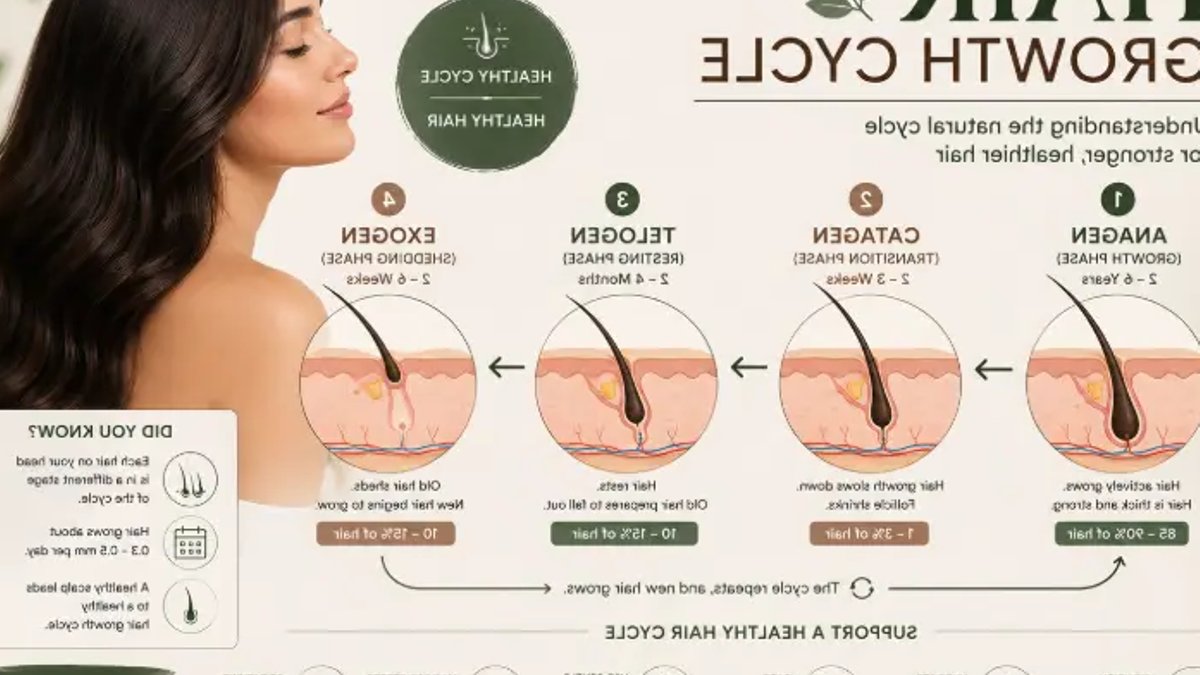
Every strand of hair on your head is going through its own private timeline, completely independent of the hair next to it. This timeline has four distinct phases, and your hair does not grow continuously — it cycles.
The anagen phase is the active growth phase, when your hair follicle is producing new cells, and the strand is physically getting longer. This phase lasts anywhere from two to seven years, which is why some people can grow very long hair while others struggle to get past a certain length — it is mostly genetic.
After anagen comes catagen, a short transitional phase lasting a few weeks. The follicle shrinks, detaches from its blood supply, and essentially hits pause. Then comes telogen, a resting phase that lasts around three months. The hair is just sitting there, not growing, not falling yet.
Finally, there is the exogen phase — the one most people never hear about. This is when the old hair is actively shed to make way for a new strand coming up from below. Research on the exogen phase of hair growth suggests it is a tightly regulated process, not random fallout.
Related: Soccer Playing Offers Numerous Health Benefits
You have roughly 100,000 hair follicles on your scalp. At any given time, about 85 to 90 percent of them are in the growth phase. The remaining 10 to 15 percent are resting or shedding. Simple math tells you that if even 100 of those follicles are in the shedding phase on a given day, you will lose about 100 strands — and that is completely within the normal range.
This is why dermatologists use the 50 to 100 strands per day figure as a benchmark. It is not an arbitrary number. It reflects the natural proportion of follicles cycling through exogen on a typical day.
When normal shedding becomes a problem, it is usually due to an underlying issue. Thinning at the crown or a widening part that does not fill back in, clumps coming out during washing rather than individual strands, or visible scalp where there was none before — these are all signs that something may be wrong.
The key distinction is whether the follicle is still functioning. In normal shedding, the follicle rests and then regrows. In hair loss conditions, the follicle either produces thinner, weaker strands over time or stops responding altogether. The hair growth cycle is sensitive to internal conditions, and when something in the body shifts, the follicles often respond first — and they do so with a delay of about two to three months.
Nutritional deficiencies, particularly iron, zinc, vitamin D, and biotin, can cause hair loss. Thyroid imbalances, both hypothyroid and hyperthyroid, can also lead to hair loss. Chronic physical or emotional stress, which pushes follicles into telogen prematurely, hormonal changes, including post-pregnancy shifts or androgen-related thinning, and rapid weight loss or crash dieting are all potential causes of hair loss.
Related: Travel neck pillows boost health in surprising ways
It’s also worth considering that the body’s response to these changes can be delayed, making it difficult to connect the hair loss to its actual cause. By understanding the hair growth cycle and the potential causes of hair loss, individuals can take a more informed approach to addressing the issue.
Platforms like Traya are built around this exact principle, diagnosing what is actually causing the hair loss before recommending anything. It combines dermatology, nutrition, and Ayurveda to look at hair health systemically, not just superficially.
Ultimately, hair fall is one of the most misunderstood health signals people encounter. Losing hair daily is not a crisis — it is biology. But understanding the cycle helps you notice when something genuinely shifts. If your shedding feels different, heavier, or persistent, the right move is not to panic or stockpile products. It is to understand what your body is trying to tell you — and then address that specifically.
Healthy hair is often a sign of overall well-being, much like regular cooking can be beneficial for mental health.

Cooking Boosts Mood and Offers Seven Emotional Perks


